
Is Your Safety Signage Up to Date?
 Most Businesses Don’t Realise There’s a Problem Until It’s Too Late
Is your safety signage up to date? It matters more than you think. If you’re unsure, there’s a good chance it isn’t.
Faded signs, missing warnings, and outdated layouts can cause confusion, delay emergency response, and leave you legally exposed. These aren’t rare problems; they are common across workplaces that haven’t reviewed signage in years.
In 2025, expectations are higher. Inspectors and insurers now treat signage as a critical safety measure, not a box to tick. If yours doesn’t hold up, you could face the consequences.
Why Standards Are Tighter in 2025
The Health and Safety Executive (HSE) has increased inspections across high-risk industries due to increased incidents linked to missing or unclear signs. Inspectors now expect signage to reflect current risks and real conditions, not assumptions or old layouts.
Insurers have responded, too. In several recent claims, signage failures contributed to workplace injuries. As a result, many insurers now ask for evidence of compliant signage before offering cover or renewing policies. What used to be seen as a detail is now a deciding factor in compliance and liability.
 What the Law Requires
The Health and Safety (Safety Signs and Signals) Regulations 1996 set out the basic requirement: if a risk remains after other safety measures are in place, you must use signage to warn or guide people.
Signs must be clear, visible, and easy to understand. They must stay in good condition and use the correct colours and symbols.
Newer fire safety laws—particularly the Fire Safety Act 2021 and Fire Safety (England) Regulations 2022—add extra requirements for multi-storey and shared-use buildings. These include clearer escape route signage and more detailed evacuation instructions.
So while the legal foundation remains the same, the expectations have grown. The law now demands actively useful signage—not just present.
Where Signage Typically Falls Short
Common failures usually come down to neglect. Sites often change layout without updating signage. Temporary signs get left up for months or years. First aid instructions point to cupboards that no longer exist. Labels on doors fade in sunlight or peel off completely.
Even small things, like using the wrong symbol or placing a sign too high or low, can lead to confusion when it matters most.
These aren’t one-off mistakes; they’re the kinds of issues inspectors routinely flag, and the types of problems that increase liability during incidents.
 What Good Signage Looks Like in Practice
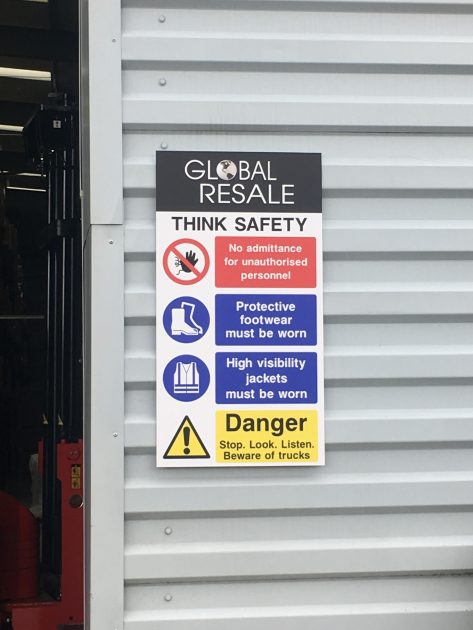
Effective signage supports safety in real time. That means it uses the correct symbols and colour coding, follows UK and international standards, and holds up to its environment—whether that’s outdoors, near heat, in a dusty warehouse, or along a high-traffic corridor.
It also fits the space. You can’t just have signs—you need the right signs in the right places and sizes where people can read and respond to them. In an emergency, a clear sign makes all the difference.
When to Review Your Signs
There’s no strict schedule for replacing signage, but waiting until something breaks is risky.
A good rule is to review your signage yearly, ideally as part of your regular health and safety process. You should also revisit it after refurbishments, layout changes, or equipment upgrades.
If a sign has faded, cracked, fallen off, or no longer reflects what’s on site, it needs replacing. If you need to guess what a sign means, it’s already failing.
 How Impact Signs Can Help
At Impact Signs, we specialise in designing, producing, and installing compliant safety signage for businesses. We don’t carry out risk assessments, but we know how to take your safety requirements and turn them into signs that meet current legal standards and stand the test of time.
We produce everything from small wall-mounted warnings to large freestanding site signs and fully illuminated fire exit signage. Every sign uses approved materials, colours, and symbols. We’ll guide you through design options and ensure everything looks professional and performs as required.
We’ve helped hundreds of businesses across the UK—small independents, national contractors, industrial units, offices, and retail spaces. Whatever your environment, we can help you get your signage right.
 Clear Signage. Safer Spaces.
Safety signage protects people, supports your legal duties, and helps your business run smoothly. Poor signage does the opposite.
At Impact Signs, we make the process simple. From one sign to a full site, we deliver signage that’s compliant, reliable, and built to last.
If you’re ready to improve your safety signage—or just want peace of mind—get in touch. We’re here to help you get it right.
Further Reading
Information and Health & Safety Signs
The Top 5 Materials for Durable and Attractive Building Signs